Saturday, 25 April 2020

A virus on the landscape 3 - Easter lock-in


Day 24
In the misnamed Land of the Free (people are anything but), or Land of the Blond Cuckoo, the toll of deaths in New York is horrifying. So much for the country being open again by Easter - which is what their delusional, mendacious and bad president promised a few weeks ago. Bernie Sanders has realized he cannot gain enough delegates to win the Democrat nomination for president. He has ‘suspended’ his campaign. In other words he wants to spoil Mr. Biden’s party at the convention.
I plant some chard seeds.

Day 25
Today is Good Friday. In normal circumstances millions of people would be driving to the country’s national parks to explore the British landscape. In Wales the police report they will arrest people trying to do what comes as instinctive in this season. It is a sad time when town dwellers cannot go and get some pure oxygen into their lungs. Having always had space around me, even when I lived in a city, I am heartbroken for urban people confined to quarters in this beautiful spring weather.
I remember an old wives’ tale relates that whoever in the household sows parsley on Good Friday, wears the trousers; and, it is alleged, Good Friday is the only day that Satan has no jurisdiction over my veg patch. Neither of us sows parsley.
I plant lettuce seeds. I think neither Satan nor God are watching.
Moreporks in Queenstown prison
Day 26
I am starting to feel how a caged bird must feel when confined to an aviary. I remember the Kiwi Birdlife Park near Bob’s Peak in Queenstown, New Zealand. Seeing moreporks^ looking down at us with glazed eyes from high up in their boxes was saddening. They had a small area in which to fly but what was the point? There was nowhere to go. There was no way they could spend time with others, go for a nice long fly or visit the golf course. It makes me think that in this age, when computer imagery can provide all experiences in education about natural history a child can need, we should free every bird held in captivity.
Anyway, lots of citizens will be feeling like moreporks.

Day 27
I am in Australia today. Not literally, but we were supposed to be coming to the end of our fourth week in Woodend, Victoria. As a bit of relief from the intensity of reading about the history of the Zulu nation in The Washing of the Spears, I have sought Australian contemporary drama and crime with Truth by Peter Temple. A newspaper columnist this week places this book in his top ten best crime novels published. Temple wrote two other crime novels set in Melbourne. They are good reads once you fathom the Aussie cop lingo.
I am also in Australia in my head, enjoying being with our Matthew, his wife and the grandchildren. And going for walks along the tracks into the forest, listening to my favourite Aussie bird, the Magpie, issuing its ‘bottom of the bottle’ warble.

Day 28
We walk for two hours across the silent fields and parched earth. The crops that broke through the earth two weeks ago are stuck. It is cold today. Spring is suspended.

A friend who lives in rural, southern France wrote to me this week: “Enforced isolation has prompted an increased awareness of my surroundings - the blue skies are empty of vapour trails - we are 33,800 feet below the Madrid-Mahon and the Lisbon- Berlin flight paths and so many others that crisscross the sky above us. Our rural solitude is enhanced by the Jackhammer drill sound of the woodpeckers, the cry of the circling buzzards and since last weekend the call of the cuckoo.” It sounds wonderful. We were booked to go and stay with him and his wife in June en route to Lago di Bolsena. C’est la vie.


Day 29
School prefect Raab, (Headmaster Boris is released from hospital and recuperating in the sanatorium), says today we have at least three more weeks confined to quarters. Despite not being able to play golf I think we can manage that. There is still much to be done in the veg patch, the kitchen and the reading room. My shelf of new books is still crammed. There are histories on: (OIiver) Cromwell’s England, Vietnam, Arnhem, Dresden, the Silk Roads, the wars for the American West, the wars at the Democratic party’s convention in 1968, the East India Company, the last of the Tsars and Brian Clough. There is fiction about or by (Thomas) Cromwell’s England, Maigret’s Paris, Anthony Trollope, Robert Harris, Dorothy Sayers and Brian Clough.
We just need some rain for the patch.

Day 30
Spring is reactivated, as the wind swings round to the southwest. It is time to plant more potatoes and the remainder of the veg seeds.

Day 31
Despite dawn until dusk sunshine and warm temperatures the mood is darker today. We have at least three more weeks of this incarceration. I avoid the newspapers’ obsessive reporting of the virus. I leave the radio silent. But then DB sends a copy of a report from the Henry Jackson Society entitled, Coronavirus Compensation? Assessing China’s Culpability and Avenues of Legal Response. Nobody locked in at home can ignore the economic cost of this experience. It is true that China does not play by the same rules of international law that we, in the so-called West, expect other nations to play by. China appears to have no regard for a rules-based international system. So it is all too easy to think that China IS culpable and this year it is kick-starting its march towards global supremacy.

Some commentators on the current position are getting itchy feet. They want a lifting of the barricade. They want to start re-building lives and economies. It might also be time to examine the case against China.

To soften the mood I plant seeds of French bean and Sweet Pea.

Day 32
Every morning on my walk around the ‘estate’ since the first seed sowing I stop to look for the first signs of chitting. I am dubious that the leeks are showing, also the carrots. It is so cold at nights I am not surprised. I just hope the seeds did not get frosted this week.

Day 33
I find it difficult to believe we are up to Day 33 since our cancelled flight to Melbourne and subsequent incarceration at home. I make my first visit to a supermarket. This is hardly an exciting excursion. We have to queue to enter the building. I walk around shying away from other shoppers. They shy away from me. One of them could poison me with the virus. They probably think the same about me. I want to escape.

Day 34
One newspaper headline this morning reads seventy year olds could have to be locked in for twelve months. I don’t think I could stand that. I would have to break out. On the morning Zoom call with the family we learn that Australia could prevent incoming flights for the remainder of this year. That is too awful to contemplate.
I feel a lack of making plans. Part of the joy of life is having something to look forward to. Seeing the grandchildren – in Leeds, Leicestershire and Australia – and doing things with them has become a large part of our lives. Not knowing when we can resume this ‘essential activity’  - I hope you read this Headmaster - has created a void, for them and us.

Day 35
Today I am transported to the garden at Trelissick at Feock in Cornwall. In 1974, during our first stay at Crantock after our marriage, we visited National Trust gardens in May. (My dear wife had just given me a life membership of the NT at a cost of £75!) Trelissick’s aspect is south over the estuary called Carrick Roads. This is the dreamily romantic landscape of a pirate in Frenchman’s Creek by Daphne du Maurier, the King Harry ferry and our lazy cream teas in St Mawes. Azaleas and rhododendrons thrive here and there is one yellow variety, rhododendron luteum, which has a fragrant and exotic smell. Years later I bought a shrub of the same genus, planted in half a beer barrel on our terrace. It has just come into bloom. I stop to sniff it each morning; thus am I back in Trelissick.
The gloom concerning the unknowing when this lock in will be relieved is lifted by our holding an illicit tea party for six in our garden. Today is our neighbour’s birthday. She lives alone, is a very sociable person under normal circumstances and someone who prefers the company of others to her own. Cakes had been baked and we sit two metres apart in our summerhouse and orchard, buttoned up against the cold East wind.

Day 36
It is five weeks ago today that we were due to fly to Australia. We are still sad at the missed trip. The pattern of life is now becoming a trifle tedious for the first time. However, we have some welcome visitors to our landscape. Our neighbouring farmer has half his flock of sheep in his field next to ours. So, we open the gate and I now have twenty-five Mules* to talk to as I work in the patch.
The peas, onions and leeks are showing above the ground. At long last there is some daily growth in the produce to spot. Yet, as we have had no rain in April I have to water all the seedbeds every evening. The first harvested produce of the year is the rhubarb. A crumble is in the oven cooking.
We have another illicit tea party with friends the other side of the village. Being model citizens we sit two metres apart as we look out across the stunningly beautiful Wharfedale valley.
'We gated too?"
Day 37
On the early morning walk around the paddock I am followed by the twenty-five Mules. It’s a bit like Grandmother’s Footsteps; I walk, they walk. I stop and look around and they stop. I start, they start. Charlie the goat gives me the cold shoulder as if to say: “get you and your new women friends”. He turns away and does not greet me.
I am now reading Trollope – Anthony, not Joanna. My mother was a keen reader of his novels. I am slightly ashamed to admit that nearly twenty years after her death I am only now getting round to reading such delicious prose. The Warden is full of satirical references to the Church of England, Fleet Street and the Bar. What obnoxious men are the Archdeacon and John Bold. Yet it reminds me that the Church of England is being very quiet in the current state of affairs. I am so heartily tired of the television news coverage of CV I long for some juicy bits of distracting news. News such as Kim Jong-un having gone missing in North Korea, which is fascinating. I would welcome some sage words from the Archbishop of Canterbury. As Trollope might have written: the church is full of aristocratic souls, men and women not in want of wisdom, but able to share with the common man some advice on how to make life a little more rewarding.

Day 38
Today I am in the Hebrides. I am grasping with forlorn anticipation thoughts of whatever new landscape I can. Our good friends are organizing a trip for the six participants in the current Saturday virtual drinks party. To look forward to a journey to the Western Isles, albeit in 12 months time, is a wonderful idea. We shall need to dust down our copy of Compton Mackenzie’s Whisky Galore, a book I have read twice and shall enjoy again in 2021. As OTM says, my wife may be tempted to take up scuba diving to search for the remaining bottles of whisky lying at the bottom of the sea.

Day 39
I am off in Barsetshire again today. The warden is about to resign and the odious Archdeacon cannot stop him. Hurrah for the warden. Yah boo sucks to Mr Bold. On the other hand perhaps a modicum of reform was needed in the Church. On further thought, a bit more is still required today.
Headmaster Boris still has a sick note from matron. He has brought in an inspector from the Department of Science – which trumps everything Education and the Foreign Office have to offer – and Inspector Witty says I may have to be locked in for another 12 months. Bugger that I say.

Day 40
It’s day 40 already. I can’t say it has flown by. I am not a particularly religious soul – I like the Communion service using the 1662 Book of Common Prayer because of the words and implicit wisdom – yet I consider these forty days. Scholars of the Bible write “40 appears so often in contexts dealing with judgment or testing”. Yes, we are all being tested.  In Genesis, God destroyed the earth with water, bringing rain for 40 days and 40 nights. Could we have just a couple of day’s worth now please? In Exodus Moses spent 40 days and 40 nights on Mount Sinai. It was all right for him; we may have to spend 80, 120 or 240 days and nights in our private abode.

_____________________________________________________________________________________________________________
^ Morepork, ninox novaeseelandiae, is the only surviving native owl in New Zealand. The Maori name for the owl is ‘ruru’ comes from the sad song that is repeated at regular intervals.

* A mule is a cross between a Bluefaced Leicester ram and a Swaledale ewe.

Thursday, 9 April 2020

A virus on the landscape 2 – From China with Love

Day 11
The Prince of Wales has the blasted virus. He’s all right though because he is holed up in his Scottish pile with a small band of his staff. Some Scots are not best pleased at this news. He might have brought his illness from London and infected some of their citizens.
Headmaster Boris also has gone down with the bug. As has School Prefect Mr. Hancock – not the one in the lift with ‘eight persons’ but the prefect in charge of health and the NHS.
It was another backbreaking day in the patch. Creeping buttercup has long roots and every little sod (of earth) has to be pulled apart by hand. The long-tailed tits and red kites are keeping me company; the former are flitting from one tree to another uttering their cheerful tweet; the latter wheeling above issuing their mournful cry. Yesterday, high up and riding the thermals I saw a pack of over sixty kites, flying large circles and eventually moving off towards Harewood House where they are fed.

Day 12
I made my first break out for six days. It was an exciting two miles trip in the car to the local supermarket in Harrogate to buy a hard copy newspaper (we have the digital version on other days) and hunt for yeast, bread flour and carrots. Sadly none of these were on the shelves that are mostly stripped bare. My excitement of breaching the gate abated.
So it is back to the patch and by day’s end I have completed weeding the area where the first vegetable seeds will be sown. What do I think about during these long hours of toil in the patch? I suppose similar thoughts to those of Haruki Murakami in his book What I Talk About When I Talk About Running (2007). Murakami was training for the 2005 New York City marathon. I am training for the 2020 Covid-19 Summer Lock in. Except, I am not training, I’m actually in it. I am up and running.
I am often bemused by my awareness of location – my brain can suddenly transport me to somewhere in the world, it is not unusual for a place visited dozens of years ago to come to mind, quite randomly, when I remember whom I was with and where we were going. It is remarkable how often some places come to mind after so long a period. Today it was a walk in the snow-covered pine forests north of Vancouver, British Columbia, in the winter of 1967/8. With my cousin and a university friend we drove north to a First Nations village. Here I saw for the first time indigenous Canadians with no jobs, no prospects, nothing to look forward to except the next drink. There was old beer bottles strewn across the derelict land interspersed with the occasional wreck of a car without its wheels. This was hopelessness incarnate. I think some more about 1968. What a year that was! Moving up my reading list is An American Melodrama: The Presidential Campaign of 1968. I remember the assassinations of Martin Luther King, Bobby Kennedy, Negro riots, anti Vietnam War riots, the ‘abattoir’ of the Democratic Convention in Chicago. Oh yes, that was quite a year. There were even student protests and sit ins on the campus of Nottingham University. Students are so well behaved and law abiding nowadays.
A second trip to ‘outside’ is to the village pub to collect our supper. It is not only feels good to support the pub – which like every small business will be experiencing hardship – but it gives me a second night off from cooking this week.

Day 13
Like many other house prisoners we have installed Zoom on our computers. On Saturdays we have weekly virtual drinks parties with friends in Yorkshire. Today we also hold our first Zoom hookup with all three of our kids and their families. Wooded, Victoria, Australia; Market Harborough, Leicestershire; Leeds, West Yorkshire and Kirby Overblow, North Yorkshire are all looking in and describing their best bits of the week. The Aussies are toasting marshmallows on an open fire bathed in autumn sunshine. Mount Macedon and golden maple trees shine in their evening glow. In North Yorkshire it is snowing. It is the first day of spring!

Day 14
Charlie and I are most impressed by the president of Belarus. “The strongman leader of Belarus is promoting his own unique recipe for staying healthy: drink vodka, work hard in the countryside and visit the sauna.” Now as someone who gave up gin in favour of vodka four years ago this is welcome good news. I drink vodka, (not on Mondays to Thursdays), toil in the patch (every day except the Sabbath), and have a hot shower (several times a week).  So if I follow President Alexander Lukashenko’s dictum I will keep free of the virus. Belarus is not a country in which I have travelled but it sounds like an attractive landscape. There are 9.5 million souls living there and as of last week the shops, markets and theatres were all open doing brisk business. I reckon we should head off there immediately I have my vegetable seeds in.
Back in the patch I am digging again. I have a game that keeps my golf putting in trim. I have set up a bucket in one corner and each time I unearth a stone I lob it into the bucket, keeping in mind: ‘Keep your head still, breathe in…and don’t leave it short’. A golf professional has also come up with Chipping Snooker; I have set up a series of different sized containers at varying distances from a mat. I then have to chip a golf ball into each.

Today my wife remarked she had the first twinge of concern we are in this incarceration for a long time. I share her thoughts. The novelty of the new life is starting to wear off for both of us. We are only two weeks in. How many more to go?

Day 15
It takes a long time to get motivated to do anything today. The likely length of the lock in is sinking in to my mind. I dig. I daydream about walking the Lakeland Fells. I make a few telephone calls to friends.
Our afternoon walk up our middle lane provides us with respite. At the highest point there is a clear, uninterrupted view up Wharfedale. There is Ilkley Moor to our left and Nidderdale to our right. Oh, how I long to get up there and stride out – and call in for a pint at The Craven Arms in Appletreewick.

Day 16
There is more good news for vodka drinkers of the world. A firm in New York named Air Co is taking captured carbon dioxide and turning it into vodka. So every time I pour a shot, or two, I am helping save the planet. Two positive steps are achieved with one slug. However, this vodka retails at $65 a bottle and…I notice that today is 1st April. So maybe Mr. Trump is having a joke with us.
I continue to dig for virus.

Day 17
The wind has veered to the west. It brings different sounds and smells to those from the north of the past few days. I am now reading Philip Pullman’s The Subtle Knife, the second volume of His Dark Materials Trilogy. If I cannot go out into my local landscape then there is nowhere better to be than with Pullman. The story in this book moves between three landscapes. Pullman calls them universes.
Having watched the disappointing 1979 film Zulu Dawn last night it has provided the inspiration to sketch out a bit more of the next landscape blog to be titled kwaZulu which is about the men caught up on the landscape where the battles of Isandlwhana and Rorke’s Drift were fought in 1879.

Day 18
I had a dream about Oxford last night. This is not surprising because it comes into Philip Pullman’s book. I dreamed about the people I worked with at Blackwell’s. Curiously I was firing a member of staff. The Ashmolean and the Bodleian Library featured in the dream.
Digging in the patch is getting difficult. The ground is hard and compacted. We have had no rain for over two weeks.
Are you talkin' to me?
Day 19
At this time of year, especially this year as I am out in the patch for many hours each day, I remember my father who every spring loved to recite this poem:

Spring is sprung
The grass is riz
I wonder where the birdies is
The birdie is on the wing
But that’s absurd
The wing is on the bird

My dad would without fail giggle his way through this as, en famille, we drove to our annual Easter walk in the Peak District. At the time I was ignorant of the author. It is Ogden Nash. My father was neither a great reader nor a bookish man despite manufacturing them. But he had an ear for music and absurdity in song and verse.

Day 20
I am covid out. My three weekend newspapers have little else to write about. I have had enough. It’s back to the patch. I decide that when ‘I stand and stare’ across my landscape I will record every species of bird I see in 24 hours. They are: coal tit, blue tit, great tit, long tailed tit, carrion crow, wood pigeon, pheasant (grrh, I hate them), great spotted woodpecker, blackbird, magpie, dunnock, bullfinch, chaffinch, red kite and goldfinch. We usually see robins and nuthatches but they are keeping away today. I also hear a tawny owl.
We both toil some more in the patch. I reckon one more day will see it dug all over. I sow seeds of leek and carrot, as the day is so warm. We just need some rain.

Day 1 before the dig 
Day 21 - after
Day 21
One aspect of this lock in is that we have all had to learn to reset our life’s objectives. With no end to the emergency identifiable I find it best to shorten plans and confine them to the day’s ambitions. (‘Setting the day’s ambitions’ is an activity my South African based sister and her family installed in their routines when the children were young. It is a good activity. Thus one avoids being disappointed by failing to complete a long list of chores or tasks.)
Today we completed the weeding of the veg patch. It has taken since Day 1. The hard graft is over. I sew some more veg seeds as the sun continues to shine. It is almost bliss here.
The robin and the nuthatch put in an overdue appearance. I suspect they did not want to be a statistic on yesterday’s list.

Day 22
Headmaster Boris is in hospital with the virus. This is sad and disturbing news. Also School Monitor Gove has it too. There is some good news from Westminster; we now have a believable leader of the opposition.
After sowing more veg seeds and onion sets we take off into the lower Wharfedale landscape for a 5-mile walk. Then I am back in my latest read; The Washing of the Spears; the rise and fall of the Zulu Nation by Donald R. Morris (1966).
with apologies to Richard Chopping

Day 23
The North Yorkshire landscape remains looking beautiful. There is no blight. There is no infection. As I talk to Charlie on the morning walk I reflect on the calamitous state of affairs in the United States. New York City is losing as many citizens in a day that the whole of the UK. In China it is announced that there are no new cases on the virus. In the province where the virus started people are allowed out. Life is getting back to normal. The 8-lane highways are full of traffic again and the airport is congested. Yet across the US hundreds are dying. The country’s president shows no national leadership. It is highly questionable that the US will ever be a global economic power again. The president and the citizens show little desire to be world shapers. This leaves the road open for the Chinese to move right in and become the single, global economic power. Their singular, Communist influence is about to be unleashed on us all – From China with Love!

Thursday, 26 March 2020

A virus on the landscape

Day 1
We awake remembering the taxi for the airport is due at 8:10 a.m. The flight to Melbourne is at 1:10 pm. The bags are packed, time for a quick coffee. Then the 6-month long dream of a trip to Australia then turns into a nightmare, as yesterday’s cancellation is now a reality that stuns our waking brains.
In all fairness the trip has been off-on-off-on for days. Now we have to admit defeat. The pesky virus has won. That does not prevent a mood of depression that hits us full on.
Six hours later I begin to look at what positives could come from an enforced six weeks at home, possibly incarcerated within the limited landscape of house and garden. At least we have a garden, many others don’t. I come to the conclusion I had lost interest in our vegetable patch. Ah ha!  So maybe now I can launch myself into a project.
Walking out from the village in warm spring sunshine is unreal. It seems that there should be something wrong with the landscape that is preventing travel and closing workplaces as well as killing the vulnerable old. Where is this virus? Can I see it? Is it lurking in the clouds, black and threatening like a thunderstorm? It doesn’t feel right that we cannot see what is closing down our normal way of life.
Tilling the earth seems like a wholesome and natural activity, so I set to and started weeding the vegetable patch. I have a long way to go. I plant a new, young gooseberry bush and a redcurrant shrub. Untainted life will soon be offering fruits.
My wife Liza has had a sore throat 4 days; we hope it is just a cold!

Day 2
Having booked to play golf as usual on a Wednesday, discretion gets the better of me, as I defer to the thought that if Liza has got the virus I should not go to play golf with a bunch of upper 70’s blokes. It would not be prudent to kill off one’s buddies, especially when I have taken some money from them of late. Anyway, it is spotting with rain, that won’t make it much fun. So, with reluctance, I stay at home. I regard our house and garden as ‘inside’. Everywhere else is ‘outside’.
The outside news gets worse everyday. More institutions close yet schools stay open for now. Are we seventy-year-old people really going to have to stay on our properties for up to twelve weeks? This really is frightening. Once again I regard us as fortunate; we have a garden and some space.
I feel I must go out. Liza is feeling ill but we still believe it is not the virus but a cold. We shall know tomorrow. So I drive to the post office, (to dispatch the Aussie grandchildren’s gifts that were packed to go with us), and then to RHS Harlow Carr garden for a walk and to buy vegetable seeds. The garden is coming to life in the weak spring sunshine. Red rhododendrons, dwarf daffodils and dogwoods bring colour to what should be a normal view. But I still see a landscape that should have some danger sign across it: ‘THE END OF THE WORLD IS NIGH, BUT WASH YOUR HANDS FOR HALF A MINUTE, THEN YOU MIGHT LIVE ANOTHER DAY’.

Day 3
The outside news is bad. Stock markets continue to free-fall. The pound sterling is at its lowest level for 30 years. Even worse, the cricket season may not take place. All schools will close indefinitely from 20th March.
The inside good news is that Liza is feeling better so it would appear she has nothing more than a cold.
There is some encouraging outside news. Joe Biden will almost certainly see off Bernie Sanders for the nomination for the Democrats’ candidate for the US presidency.
Having bought my vegetable seeds I must now get digging in the patch. But today it is too wet and cold to dig. I chop some firewood, prune some shrubs and retreat to the summerhouse. A first! A first sit in the summerhouse this year. Hurray!

Day 4
Our granddaughter in Australia has found the answer. Gwen says: “If I find a Conivarius I’m going to fart on it. That should do the trick.”
Her grandma in Wales has seen the positive extra benefits: “That’s the spirit Gwen. It should also help evacuate the surrounding area should people not be observing the correct social distancing.”

I search for normality with a first visit to the golf course in over a week. The sun in shining, there is no wind: ideal golfing conditions. Yet it is not normal. Dozens of others have had the same idea; the thought that you can’t catch corbyn 19, (or is it covid 19), if you are outdoors so long as you remain a club’s length away from everyone else. The flag poles have grey water pipe insulating foam attached to them so the ball won’t go all the way down to the bottom of the hole and we don’t have to touch the flag. The professional had an inspired idea.
The small bar in the clubhouse is closed but the lounge is open and chairs set a metre apart. It is reminiscent of “the few” waiting in armchairs by their Spitfires as they prepare for another sortie in The Battle of Britain. The young Tykes of our club believe the over 80s should not be anywhere near them.
 “If they catch it they’ll expect to be taken to hospital and take up key resources. We are all going to die sooner or later, them a bit sooner than they thought perhaps.” It is not a position I can argue with.
After golf I am back in the patch, ‘digging for victory’ – to borrow the Second World War phrase used by allotment holders in the 1940s. Or it should be ‘digging for virus’. There has been much comment in the media of late, comparing our predicament – both health wise and economic – with the experience of Londoners during the Blitz in 1940.

Day 5
From now on my first excursion each morning, now we are largely confined to quarters, is to walk around the estate. It sounds grand but it’s just less than one acre. The joy of this at such a time of the year includes the morning chirrups of blackbirds, robins and wrens. Having planted a few trees last year, and the replacement soft fruit bushes this year, I also look every morning to see how each has chitted a bit more since yesterday. At the top of our paddock is a gate into our neighbour’s. Their friendly goat, Charlie, is there to greet me each day. I stop to give his neck a scratch, which he enjoys with a grin.

Headmaster Boris has declared we are now all gated. (Having been gated as a punishment at school over fifty years ago I remember that there are ways of temporarily escaping this restriction.) Boris has declared that under 70s can visit food shops only (that’s me excluded); to which I add the golf course but not the clubhouse, now that pubs, churches and gyms are off limits. So it is another day in the patch – weeding amongst the strawberries, raspberries and last year’s parsnips. I am preparing for the long haul and will soon be sowing vegetable seeds that will yield crops to keep us sustained through the long summers, autumns and winters of the next three years. If the chief medical officer is correct we could be locked down for three years. Three years! I could be dead by then.
So for an indeterminate length of time the landscape for us two Yorkshire figures is an orchard, a veg patch and a paddock.
To keep the brain being ossified I have read three books in five days; Rounding the Mark by Andrea Camilleri (Inspector Montalbano deals with death, illegal immigrants, the chaotic Catarella and the delicious Livia in Sicily); Maigret’s Patience by Georges Simenon (the 64th novel in this inimitable series); and The Looking Glass War by John le Carré (Penguin has just reissued this brilliant satire of the Cold War paranoia in Whitehall). Next up is The Making of the President 1964 by William Manchester. I am re-reading this in a year when we are critically short of candidates of the stature of Kennedy (Robert), Nixon, Johnson, Goldwater, Rockefeller, Scranton and Lodge – all flawed personalities but honourable leaders (with one exception). The similarities between Goldwater and Trump are uncanny.

Day 6
Mothers’ Day. Two bright sparks in the village have set up a Facebook account for the church and a camera in front of the altar. The Rev. Ralph Hudspeth holds a virtual service. What would my mother, (116 if she were still with us), have made of this fiasco we are in? No doubt she would have carried on phlegmatically as she did in the last war and through all subsequent crises in her life.
Another thirty square feet of impacted soil in the patch is dug over today. This is followed by completion of the fourth book of the week; the hilarious golf memoir, The Downhill Lie by US crime novelist Carl Hiaasen. In this book he addresses the insanity played out by millions of figures across the world every week when blasting a little white sphere around a park with eighteen holes.

Day 7
The sun is shining; it is a brilliant and bright spring morning. The golf course is open (most of the club buildings are closed) so where better to spend a few hours? The Times correspondent in Scotland writes today that many courses north of the border are fearful for the future. Club membership is falling throughout Great Britain. This crisis could put many out of business. As of today it is still not contravening advice to play. We don’t go nearer than two metres to our fellow players; we touch no course furniture - neither fixed nor loose. The five of us are of the same mind to get some exercise, doing what we like and in good company. We shall continue to play whilst the going is good.
Whilst my own rural landscape is tranquil and largely deserted the towns are full of shoppers rushing about like ants around their nest, hunting for food with which to stock their larder. It is a frightening world where many folk are obsessed with provisioning their cupboards to bursting point. There are books to be read, films to be watched and gardens to be dug; these are the simplest yet most rewarding life activities.
Across the world, parents are homeschooling their children, and in the process learning themselves; that teachers are unsung, and underpaid, heroes. Step up Mr. Gisborne – the other one.
Day 8
We are all now in ‘lockdown’ as the newspapers like to call it. Headmaster Boris has banned us all from going anywhere – we must stay at home. My golf club has e-mailed to report that the course is closed from today.
So the veg patch is the main project now plus the books. I realize my wife and I are fortunate to have a bit of space in which to breathe the country air and a large library.
The view of the landscape across the fields looks stunning this morning. It is bathed in bright sunshine and the blackbirds are definitely animated with the thought of nookie.

Day 9
On my walk around the paddock once again I am struck by the invisible destructiveness of this virus and the purity of the air and the landscape before me. I am reminded of the great twentieth century philosopher, Anthony Aloysius Hancock. Trapped in a stuck lift with ‘eight persons’ he muses about air and the shortage of it in their predicament and the likely demand for it as the world population grows so fast.
“Too many people breathing too little air.
“It’s a funny thing air, isn’t it Doc? You can’t see it. You can’t touch it. You can’t smell it. But its there.” He could be talking about the virus.

Day 10
On my morning perambulation around our plot – it would take under five minutes without the chat with Charlie – I am struck once again by the dichotomy between the inspiring North Yorkshire landscape, bathed in warm sunshine with the birds full of lusty song, and our country’s position on the brink of a precipice, about to tumble into a public health and economic depression. I do fear for our kids’ and their generation and our grandchildren too. The economic damage being perpetrated on this country will thrust uncertainty on all who expect to work and gain financial comfort before they in turn retire. We are the lucky ones who look not for work but leisure and peace. Is this ‘lockdown’ worth the effect it will have on the lives of our children’s children?
A virus on the landscape 
will be back
in....
Fom China with Love

Thursday, 13 February 2020

Kettlewell


Some boffins in London want us to cut our consumption of meat and dairy products by a fifth. They did not consult me before coming up with this arbitrary number that you and I are to follow. They picked this number, without providing an explanation, if I wish to contribute to climate change reduction at the start of this third decade of the century. I doubt they consulted the farmers in Kettlewell and other small farm owners in villages of the Yorkshire Dales. I shall give them the benefit of the doubt over consulting with a few farmers in Lakeland. However, the bright sparks from English Nature and the Committee for Climate Change (CCC) had already made their minds up before stepping out from the M25; they want fewer sheep on northern England’s hills and fewer cows in the valleys. They are like that, these ‘suits’, they don’t listen to what farmers – with centuries of knowledge accumulated by families managing the land productively – tell them. These Westminster bureaucrats know only what they want to know, gleaned from pictures and United Nations scientific journals.
Kettlewell is, statistically, a remote village in Upper Wharfedale six miles from Grassington with a population of 340 in 2015 and thirty pupils in the school. There are plenty of similar villages on the uplands of England. What is remarkable about Kettlewell is its exquisiteness and tranquillity. It nestles “in the shelter of majestic sweeps of mountain limestone clothed with the sweetest herbage.”^ There is neither railway nor motorway, just a single-track road meandering up the dale. This isolated gem of habitation boasts a rich cultural heritage interwoven with the lives of colourful characters that made their marks upon this landscape over two thousand years.

My first enrichment of the local history was in 1974. I was on a stag weekend. The focal point for our carousing was The King’s Head Inn, one of three public houses in the village. A dozen of Nottingham’s finest yeomen required a full weekend of hard drinking to see off the bachelorhood of G.J.B. Minor skirmishes included the rugby tackling of ‘the stag’ on a tarmac road (with resultant black eye and grazed cheek) and a magnificent tumble from a tabletop in the pub by one joyously inebriated fellow who was leading the singing with pint in hand. Had we been more attentive to the local history we might (but on reflection, probably not) have born in mind ‘Awd Platt’, the village smith in the mid 1800s who, like our own G.J.B., was “a man of great sincerity and force of character…full of life’s energy”. John Platt was also a temperance advocate, unlike G.J.B., and many a man attributed his better state in life to John’s advice that ran: “there’s no harm in a’nod glass if a chap wod nubbut stop theear”.

The next time that Kettlewell connected to my world was a few years later when I first met ‘Whale’. Readers of my chapter on Crantock will remember the Beasts of the Jungle (undergraduates of Cambridge University) visiting a house called Kareena. Whale was one such beast. That first encounter is memorable. Lunching at my in-laws (the Dog and Doggess) one day I was told there was another visitor. “Who is it?”, I asked my wife. “Whale”, she replied. Shortly after there was the deep, throaty sound of a motorbike in the driveway. We went outside. The largest BMW bike I have ever seen was being leaned on the wall by a tall man clad from head to toe in black leather. He pealed his helmet off. I was introduced to a seventy-year old six foot six giant, without a hair on his head, grinning from ear to ear. This was Whale, one of the Kareena visitors, who’s real name was Graham Watson.

Now Graham was a Yorkshireman. He was one of four generations to manage Lister’s Mill in Bradford, once the largest silk factory in the world. Graham was a bachelor and so, without a wife and family to drain his pockets, he invested in farmland around Kettlewell and further north in Upper Wharfedale.

Let me take readers back to 1066. Land had been ploughed at Kettlewell for some time by then. There was a carucate (approximately 170 acres) being farmed by the Normans holding the estate in this, the year they and William I won the battle of Hastings. Over the following two hundred years agricultural progress was made hereabouts and by the time of Edward I Kettlewell was a thriving village with eight carucates providing employment and food. A local culture was being embedded in the landscape by hardworking Yorkshiremen, laying down a rewarding way of life for generations that followed. Wise yet entrepreneurial farmers passed on to their sons and daughters knowledge of the land and the woods as well of the habits of the River Wharfe. (Let us remember this when I consider the village’s future, this day I write when Britain leaves the European Union and we ‘gain our independence’.)

Of the eight carucates mentioned above two were held by Elias de Knolles, three by the Abbot of Coverham and the remainder by the Arches and Percy families - all famous names over centuries in northern England. The years to the end of the Tudor period in England featured Kettlewell land being gifted or traded in exchange for favours, forfeits and debts. Land, along with sheep, was a valuable commodity upon which family dynasties floundered or thrived. The housing stock in the village grew slowly. Cottages for the farm workers and the lead mine workers (from 1658 onwards), as in neighbouring Swaledale, were small and cramped. Yet the village thrived amidst a landscape providing rich rewards for the folk that worked hard. By the height of the wool trade wealthy merchants, spinners, weavers and dyers from the nearby cities of Bradford and Halifax were acquiring houses around the village. With them they brought more prosperity and so more employment. Such a person was Clement Holdsworth who bought Scargill House, a Kettlewell farmhouse, in 1900.

My second visit to Kettlewell was in June 1989 whilst walking the Dales Way with wife and son. The route brought us past Scargill House, (of which I knew nothing then other than it was once part of a notable estate), around the maypole, and uphill past The Green to lunch at The King’s Head Inn. I remember now there was not a soul on the street, not a car or a tractor in motion. As we walked up the street, today still rimmed with ancient cottages - some with visible foundations built in the twelfth century - there came a familiar voice from a garden. We observed a house painter up a ladder with his transistor radio on. England was playing Australia at Leeds in an Ashes Test match and John Arlott’s rich voice was reaching out to us clearly  from the radio. How quaint. How quintessentially English. We had to match the mood by downing a pint of two of Yorkshire ale. What could surpass this combination of English delights? (It was slightly undermined by the news that England was being walloped by Australia.)

Like Graham Watson, Clement Holdsworth was a member of a successful West Riding family dynasty. John Holdsworth & Company of Halifax has made worsted for six generations. Like Watson, he loved Wharfedale and acquired Scargill House with surrounding land that he developed into both a family home and an agricultural estate. His son George continued the family business and it is his three sons who are featured in the stunning and emotive stained glass windows in St. Mary’s church in the village. I remember reading about the death of two of these boys in the Second World War and I was touched and saddened; John, serving with the King’s Royal Rifle Corps, died in Belgium in 1945; 

Michael was in the Fleet Air Arm and was posted missing on 24th February 1945; Michael’s twin brother Bill completed the family’s service to all three of Britain’s armed forces and survived the war as a Flight Lieutenant.

A small English village, like many others throughout Britain, had lost two young men who would never add their contribution to both an important, valued business and to a village that needed their touch. Villages and businesses in mid twentieth century Britain were left severely depleted by the war of men with talent. Yet Kettlewell was typical of rural villages and agricultural landscapes; women – many like the Doggess had served in the land army - came to the fore with ideas and vision. They too made their marks upon this land. Bill Holdsworth died young in 1969 yet his widow, Dina, took a significant working interest in John Holdsworth & Company. Women in the village came into ownership of the farms, the small businesses and even the cricket field and pavilion.

On my latest visit to the village I met the modern day human metal of Kettlewell at the weekly Tuesday coffee morning. Twelve women – some lifelong residents, some ‘incomers’ from as far afield as South Africa – greeted me and welcomed me to sit with them and talk about what makes Kettlewell the village it is today; what the threats are; and understanding the challenges on the culture being continued. Josephine farmed in the village with her husband, and she remembers Graham Watson well. “He walked into the bunk barn on our farm one day, never stopped to ask. He was in his shorts! He said he wanted a look round, which he did; said he owned the land next door. Then he walked off!”
“There used to be seven farms in the village,” said her friend Maureen. “Now there are only two. There is only one milk farm near here, up at the (Kilnsey) crag.”
Josephine added: “In my time the next generation did not want to farm. There’s no money in it. They want to go and live in the cities.” This is a common cry I have heard in small villages up and down the country.

I asked about what they thought of the boffins in London, wanting to change the use of much upland in northern England, reduce the number of sheep and cattle. Josephine has a clear memory and strong views of a visit one time. “Experts came here once. Went up on the moor where every villager exercises his and her right to put a single sheep out to graze, have been since the 1700s. They said the moor needed draining to allow tree planting.”
“What happened?” I asked.
“Well they put drains in. Of course, the moor dried up, no use to anyone; there was no proper grazing for the sheep. We told them it was the wrong thing to do but they didn’t listen. You can’t grow things on the land here. Just good for livestock.”

My talks with the locals – the latest in a long line of farmers who know this land, know how to get the best use from it, how to earn a living, how to keep it for future farmers – proved yet again that so called ‘experts’ from Westminster have little idea how communities such as this have been the backbone of English agricultural wealth creation for centuries. Further, prosperous industrialists such as Clement Holdsworth and William and Graham Watson improved the estates and houses. (Scargill House has been owned by religious movements since 1959 and continues the valuable practice of offering local employment.)

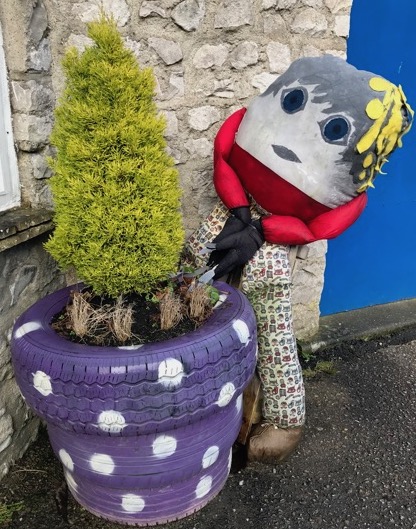
I have also discovered the real story of the renowned Kettlewell Scarecrow Festival. In 1994 a visionary local woman named Jenny Howarth came up with a suggestion for raising funds for the local school. Jenny’s mother had seen a scarecrow display in northern France and the idea came for a one-off, one-day festival – where inhabitants make and display a scarecrow outside their houses - in Kettlewell. Twenty six years later the now annual event takes place over nine days – much to the annoyance of some locals as, although it raises money now for the school, church and village hall, it attracts tourists in cars which clog the narrow streets and disturb the normal village tranquillity.

“People should cut their meat and diary (sic) consumption by a fifth to help save the planet, the Government’s environment committe (sic) has said”. So read the BBC website on 23rd January 2020. (Maybe the BBC should lose the licence fee, cut its programming costs and send their journalists on a basic spelling course with the proceeds.) Bizarrely, and in an impossibly coincidental use of numbers by another pillar of the British establishment, Waitrose supermarkets, a poll taken by them shows, “a fifth of people are now flexitarians – trying to eat more plant based meals without ditching meat altogether”.

I am suspicious about the wanton use of this number ‘fifths’. Like the current, mendacious President of the USA, these organizations use only numbers that suit them, ignoring the numbers that tell a different story. (Trump fails to tell us that under his administration his people have wracked up a national debt of $1.9 trillion.) Whilst telling us to eat less meat and dairy food the CCC should also tell us the numbers involved in Waitrose’s ‘carbon footprint’ with their import of the many tons of fresh food: sweet corn from India; peppers, celery, cucumber, lettuce, tomatoes, spinach and squash from Spain; cherries from Chile; asparagus from Peru; grapes and limes from Brazil; dates from Israel; raspberries from South Africa; bananas from St. Lucia; radishes from Senegal; and  strawberries and onions from Egypt. Much of this produce could be grown in Britain, thereby reducing our reliance on imported food that is flown in. I shall continue to eat meat, cheese, yoghurt, parsnips, beetroots, potatoes, mushrooms, cabbages and pears because I like them and they are good for me. They are also all produced in Britain. If the government is going to be dictatorial about Brits consuming less meat and dairy then they should ‘persuade’ them off eating South African raspberries in winter. Is it worth poisoning the planet for the sake of eating strawberries in January? The time to eat soft fruit, ‘home-grown’, in Britain is the summer.

An enduring life for the villagers and landscape of Kettlewell will be assured if we support its traditional position in the local and national economy, inclusive in an independent Britain (once again). If the commercial price of its produce is too high for some supermarket shoppers then subsidies paid by all the people of Britain will allow the upland farms and farmers of England to thrive. With a reduction in food imports the nation’s greenhouse gas emissions will reduce*. Kettlewell and Upper Wharfedale will return to be both a prosperous farming landscape and continue as a haven for walkers, scarecrows and nature lovers.
________________________________________________

*In a letter to The Times of London on 25th January 2020, the policy director of the Sustainable Food Trust writes “taking large areas of [UK] land out of food production and covering them with mostly coniferous plantations (the only economically feasible option) would destroy precious ecosystems…” And, “the recommendation to use additives in cattle feed to reduce methane emissions is impractical, since most beef cattle in the UK graze on grass and receive no other feed for much of the year. It is also unnecessary. Research shows that the short-lived nature of methane in the atmosphere means that emissions of cattle and sheep are not adding to global warming contrary to popular belief.” So Josephine is correct. Furthermore, grassy fields, hillsides and mountains capture carbon and pull it down into the soil.

Books:

^ For a delightful yet scholarly read about the whole of Upper Wharfedale I would recommend a book by Harry Speight titled: Upper Wharfedale; being a complete account of the history, antiquities and scenery of the picturesque valley of the Wharfe, from Otley to Langstrothdale. First published in London in 1900 by Elliot Stock it was re-published by Smith Settle of Otley in 1988.

I recommend visitors in Kettlewell to visit Simon Johnstone (from Chesterfield) who owns and runs the village store, built in 1877, where he will sell you a terrific little book: A Walk around Kettlewell; a walk back in time with pictures, history and tales of the village by Colin Hare (from the Isle of Skye, resident of Kettlewell for over 23 years.) Then sit and enjoy a pint in each of The King’s Head Inn, The Bluebell and The Race Horses Hotel.