Tuesday, 9 October 2018

Cartmel: a landscape with horses & betting folk


If you could call the thing a horse. If it hadn’t shown a flash of speed in the straight, it would have got mixed up in the next race. P.G. Wodehouse, Very Good, Jeeves

I don’t know the first thing about horseracing. Furthermore I am not a betting man. So why should I attend a race meeting in Cartmel? Being invited by a kinswoman living three miles from the picturesque racetrack was a good enough reason. With the additional attraction of a day tramping on the gentle southern fells in late summer in fine walking weather, plus tea and cake at Sizergh Castle, I was drawn once again to the Lake District. And the Cartmel peninsula was a part of Lakeland I had never been, a node of Britain that demanded inspection.

The village of Cartmel gives its name to the peninsula in the remoter south of Lakeland. This is a flat spit of land jutting south into Morecambe Bay. Modern day Cartmel is known for its Michelin starred restaurant and being the home of sticky toffee pudding. However, being a user of neither of these populist inventions, I am more interested in the founding of the community when a priory was established on the banks of the River Eea, close to the site of the racecourse. In 1190 The First Earl of Pembroke commissioned the priory and thus laid down the foundation of eight hundred years of a typically English heritage. For Cartmel you can substitute any one of hundreds of other villages in Britain that grew in a similar fashion, even if each one has its own setting, culture and mysteries. There is, however, one aspect of British life that binds these villages together. The horse, and Cartmel ‘does’ horses.

Morecambe Bay near Cartmel

By nurture I am a city boy. My earliest encounter with an herbivorous quadruped was being seated, aged two, on the back of a Gorleston donkey when on a family holiday in Norfolk. Reports and photographs reveal I was unimpressed with this experience. So when I married a country girl who believes the horse is “the most beautiful creature on earth” I decided to learn more about these animals. A trade off one time with my future wife resulted in my giving her driving lessons and she taking me for a few sessions of horse riding. The former went well with no mishaps. The latter are remembered for two hair-raising incidents. The first was when I lost control of my nag, which took off at great speed on a downhill and grassy track and forced its passage between my teacher and a ditch – ‘totally infra dig, my dear sir, you scoundrel!’ The second resulted in the traffic on the crammed Fosse Way being halted as my mount was spooked by a burned out lorry tyre lying in the grass verge and so it backed out on to the tarmac. It had a point, where else was there to go? Following the advice of top sportsmen down the ages, which is ‘get out at the top”, I retired from horse riding. This was a good move because as soon as I did I began to appreciate what intriguing and graceful animals they are. (Horses can be obstinate, nasty and cantankerous too but they probably learned such traits from their drivers.)

The horse has shaped the English landscape. The growth of the economy, the exploitation of the land and the expansion of farming were, for nineteen hundred years, heavily dependent on the horse. Horses enabled people to travel from town to town in far less time than it took to walk. Farmers hitched ploughs and threshers to heavy horses thus managing to till the land more quickly and efficiently. Ponies were sent underground to pull coal trucks away from the face of the seam. In warfare cavalry achieved superiority over infantry. Soldiers, idling away the time between battles, started to race their mounts and found that horses galloping in a straight line could run fast. It was in the reign of King Henry II that the racing of horses became common. 

Three Kings
By 1680 regular race meetings were being held in Lincoln. By 1750 steeplechasing across country was popular. The term ‘steeplechasing’ referred to the fact that a visible church steeple was used as a marker for the horse and its rider to pinpoint in their cross country race over hedges, dykes and ditches. Onlookers discovered they could make money off their mates by running a book on the outcome. Breeders discovered they could make even more money by pairing speedy stallions with fertile mares.

Would a first time visitor to the Cartmel area think that this landscape is still dependent on horses? Probably he or she would not. Set in the southern extent of The Lake District, (a name sadly in decreasing use, now folk refer to Cumbria – a modern and soulless name), Cartmel is ringed by romantically denominated villages such as Holker, Birkby, Allithwaite, Stribers, Eggerslack and Howbarrow. Few houses here, some small farms, many woods; this is not a wealthy land, especially when comparing with Newmarket, Epsom, Aintree and Sandown. Yet horseracing thrives. Horseracing is the second largest spectator sport in Britain. As we found out on a warm and late summer day in Cartmel, race meetings bring together peoples of all types and class, regardless of wealth, to have a flutter and some fun along the way. They have done for a long time. The earliest record of racing here is in 1856. Yet mule racing probably took place on this site in the fifteenth century, organized by the monks in the adjacent Cartmel Priory. Cartmel racecourse is small but attracts one of the highest crowd’s for any jumps track in the country, with up to 20,000 people attending a public holiday meeting.

Mountains, rivers, lakes, and meadows - nature’s living and vibrant emblems - all are found in their natural beauty in The Lake District. Cartmel looks north to the fells where death on the slopes is too often an occurrence as some tourists - inappropriately shod and ill prepared for rough terrain - discover too late. Cartmel also looks to the south where the sands of Morecambe Bay look benign when the tidal waters retreat leaving a vast flat area holding cockles and flounders. For all its quaint beauty the peninsula has witnessed terrible deaths of men and women drawn, with their horses, to the cockle beds in the sands between Grange and Poulton-le-Sands, now Morecambe. In 1769 Thomas Gray wrote of a Cockler in Poulton

 “driving a little cart with two daughters in it, and his wife on horse-back following, set out one day to pass the seven mile sands, as they had frequently used to do: when they were half-way over, a thick fog rose, and as they advanced they found the water much deeper than they had expected: the old man was puzzled; he stopped, and said he would go a little way to find some mark he was acquainted with; they staid a while for him, but in vain; they called aloud, but no reply: at last the young women pressed their mother to think where they were, and go on; she would not leave the place; she would not quit her horse and get into the cart with them.”

The old woman was washed away and perished. The daughters clung to their cart and drove the horse on; sometimes it swam, sometimes it waded. Finally the cart was brought to land and safety. The brave horse and the girls survived. The bodies of the parents were found when the tide ebbed, that of the father just a few yards from where he had left family. In February 2004 twenty-one Chinese illegal immigrant workers were drowned near the same spot as Gray’s Cockler over two hundred years before. This shocking tragedy inspired films to be made and songs to be written. In the decades between the two catastrophes numerous other fishermen, tourists and daredevils have died in the sands.

Yet this Lakeland landscape always entices the walker, the poet and the painter. Elsewhere in The Lake District motorists queue to enter the National Park, running their engines and spewing fumes, in order that they may eat fish and chips in Ambleside or feed the ducks at Bowness-on-Windermere. Fortunate and blessed are the residents of Cartmel and nearby Field Broughton which fewer tourists find. Apart from on seven racing days a year here motorists and gargantuan coaches do not clog the lanes. Even on race days the wily locals block the village, directing the motorized racegoers to parking at distance from the track.

My equine education has taught me far more than the horse being pivotal to the development of the English form of agriculture. That the hedges of Leicestershire are sculptured for jumping over is now easy to see. That the racecourse at Catterick provides entertainment for squaddies and North Yorkshire gentry fascinated me on an earlier racing event. That the Thoroughbred breed has been developed for speed and that the beast loves to race are now familiar to me. The city boy has now had the scales lifted from his eyes. I have learned of the completely English folklore and culture – to say nothing of the separate language - that surrounds people, places and horses that stretch back two thousand years. For Henry II’s successors the horse was an essential component of the English landscape too. Henry VII forbade the export of any horse without royal permission. Henry VIII made horse stealing an offence that ranked with the transgressions of two of his wives – punishable by beheading. Elizabeth I introduced coaches drawn by horse (in 1555 a first carriage was made for the Earl of Rutland). By the seventeenth century horse-drawn carriages ousted the sedan-chair and hansom cabs, the stanhope, tilbury, gig, brougham, landau and phaeton were all developments of a basic idea – that of the conveyance of people by horse through the landscape. It is said that Elizabeth II is never happier than when out racing her Thoroughbreds.

P.G. Wodehouse’s words should have warned me. A farmer we met at Cartmel, who keeps horses for his wife and daughter to ride and also trains horses to harness, is a wise man and my saviour at the track. When we asked him tentatively for his tip for the last race (my one wager in the second race resulting in a last place) he replied, “Oh aye, aye… Keep your money in your pocket”.

Thursday, 16 August 2018

Figures of a Landscape: an introduction


“…it was only then that I saw how tenuous, really, the hold of all these people had been on the land they worked or lived in”.
V.S. Naipaul (1932 – 2018), The Enigma of Arrival.

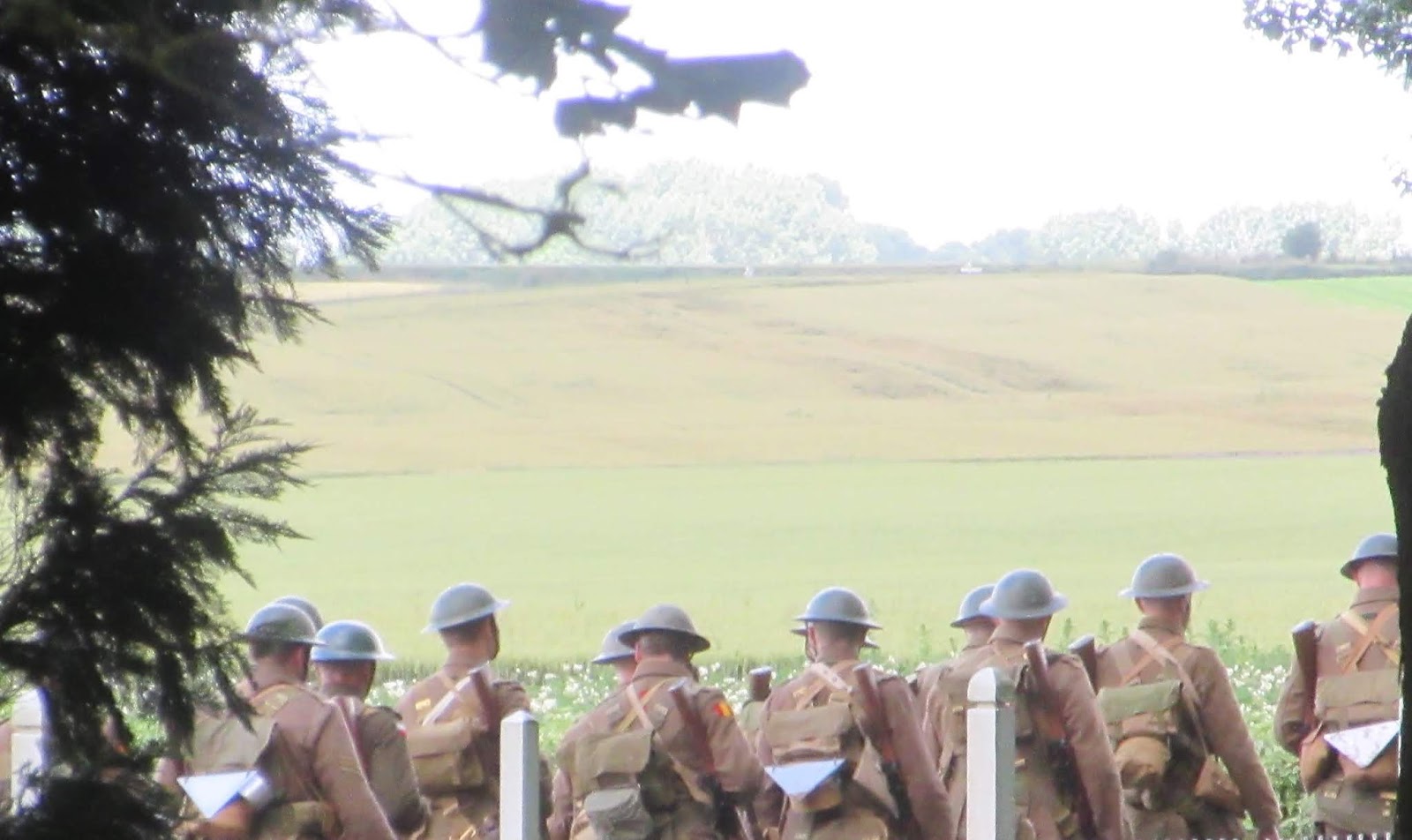
High on a hill in Picardy stands the lonely Thiepval Memorial to the 70,000 missing Allied soldiers who died on the Somme. At school I was captivated for life by the literature emanating from the First World War so I later went in search of the place.* I have twice stood there, looking up in awe at the names of the men and women commemorated. My first sighting of the acres of British and German graves was by chance, in 1971 on the return leg of a road trip to Italy. Northern France in those days had no autoroutes and the main Route Nationale took travellers directly through the warzone. Ten years later I joined a tour of the Somme battlefield, stood in the preserved trenches and went to Thiepval. In 2016 I was again at the Memorial for a one hundredth anniversary ceremony in the company of a British Prime Minister and a French President. I felt like an insignificant figure in a historic landscape, for this is a landscape still resounding with stories of men’s courage, catastrophes and compatriots. This is a land that has been marked forever by a previous generation’s commitment to war.

In counterpoint to the human induced horror experienced by the Tommies in France is the vengeance nature unleashes on mankind. On 22nd February 2011 an earthquake wrecked a beautiful city and rent the urban landscape of Christchurch in New Zealand. Picking my way around the ruins four years later I felt a similar sense of devastation that I experienced in the Somme trenches. What man can do to obliterate a landscape, nature can do to mankind.

The landscapes of Britain are now mostly protected by, and subservient to, the will of farmers, planners, developers, grouse-moor shooters and walkers. There have been rare natural disasters in recent years such as Cockermouth in 2009 and Mousehole in 1981. Yet on other continents many people live in perpetual fear for natural disasters. When such landscapes and people collide cataclysmically it is the former that often comes off on top. Fires in California and Eastern Australia with floods in the Caribbean and Bangladesh take lives and property frequently.
My interaction with landscapes includes amusing, dramatic and wistful episodes. Confrontation with a deadly serious East German border guard, (yet he smiled), in Cold War Berlin; saving the life of a buddy on icy Foule Crag in Cumbria; and gaping at the gas chambers at Auschwitz; all have left me with vivid images up to fifty years later. For me landscapes are inspirational, humbling, historical and, on the last hundred feet of a mountain climb, tiresome. Yet when standing on the summit of Ben Nevis in a whiteout one recent June my sense of triumph was matched by my wonderment of the permanence of the place.

Nonetheless, my travels in other landscapes reveal countless examples of man’s success at controlling his places. I ask myself, is this a good thing? In this new century we are learning more each year of the cost of that control; put crudely that cost is called ‘commercial development’. The scale of the downside of economic expansion (its sole purpose is to feed the billions of this planet’s inhabitants) is represented graphically and daily on our screens. Images of Indian rivers overflowing with plastic and the polluted oceans poisoning the fish stocks are ubiquitous. Today I read in my newspaper of a Leatherback turtle, washed up dead on a Cornish beach, its belly full of a plastic bag ingested in mistake for a jellyfish, and its body scarred by swipes from a propeller blade. What we see now are landscapes under pressure from man. In turn they are taking on more assistance from the elements to push us back.

This blog explores the relationship between person and place. I look at landscapes I have visited and record my impressions on how people and the land have related to one another. Some times they co-exist happily. Sometimes they do not. Forest fires, earthquakes, warfare and human internment (at Port Arthur and Auschwitz) have stamped notoriety on previously unremarkable locations. And then there is the Lake District in England, my choicest landscape of them all. How do crowded communities and political upheaval beset our island? I find the supplicatory sheep are now outlawed in areas where once they provided a living for man. I find that ‘rewilding’ is a dangerous concept, and besides, a hopeless objective as this island is too crowded to exclude people from parts of it.

The late, great Alfred Wainwright – council worker, fellwalker, guidebook writer and artist – said of Blencathra, one of the mightiest mountains of England: “This is a mountain that compels attention, even from the dull people whose eyes are not habitually lifted to the hills”. I apply his sentiments to the entire landscape on earth. It “compels attention” so that we learn to live better in it and pay it more respect.
++++++++++
* My bookshelves have long given space to the poems, plays and novels of Wilfred Owen, Siegfried Sassoon, R.C. Sherriff, Robert Graves and later a prize winning series The Regeneration Trilogy by Pat Barker. These have been joined, a century after the event, by some thoughtful and freshly interpretive accounts of the war. Readers looking for a new perspective on events that culminated one hundred years ago this autumn might be rewarded by the study of work by Andrew Roberts, Hugh Sebag-Montefiore, Gary Sheffield and David Stevenson, amongst many more. The often romantic ideals surrounding the novelists and poets are put into perspective by some of today’s writers who remind us that the British nation as a whole supported the move of going to war in 1914.


Tuesday, 17 July 2018

Kentmere


The Kentmere Horseshoe
This is a story about a Flying Squad officer (‘The Sweeney’), a hill farmer (‘Bo’) and a genealogist (‘Charles’). I met them in Kentmere near Ambleside, a remote part of Lakeland landscape, whilst I was fell walking with a buddy. The three individuals didn’t know each other, they most likely never will. Nevertheless, for one day they were connected to us by a shared passion for a piece of landscape that is under threat.

The Sweeney (he even looked like Inspector Jack Regan/John Thaw) was 79. He told us it was his birthday. He looked more like 89, as he gasped for breath and wheezed alarmingly. As we descended and he ascended a hill called Froswick, a western flank of the Kentmere Horseshoe, we had stopped to say hello. When he recovered a little we spoke the usual pleasantries with a fellow tramper – the sort of inane but inoffensive comments that roll out; “Great day for it”, “beats working” and “makes you feel good to be alive”, although saying the last we may have been presumptuous for The Sweeney who looked like he may peg it at any moment. But when we asked him where he was walking to and from, he appeared to relax and told us a little of his past and why he was here. He had retired early from the Squad (I calculated when he was 54) after a career “you don’t want to know about, it was a terrible time…the corruption, the graft…oh, I could shock you with what I saw and had to put up with. I got out the earliest I could. I witnessed terrible things. Walking these hills helps me forget”. Clearly he finds refuge and peace in his life on the Lakeland Fells. Before we left him he offered us some foul looking cake, which we declined graciously. We hoped he would recover enough from his exertions before continuing his climb.

As we walked along the base of the valley we suddenly became aware of a sheepdog darting up and down the fell side. It was making a bit of a hash of controlling a small number of old ewes. Looking like Bo from The Dukes of Hazzard, a strapping young farmer astride a quad bike was in pursuit of his pup and plainly unimpressed with its efforts; his language was colourful to put it politely. After five minutes the canine had completed the required placement of ewes in a field corner near our track. We were able to say hello to Bo who appeared more than happy for a chat and a break from his work. Bo is a second-generation hill-farmer renting his land in Kentmere from The National Trust. He used to maintain a flock of Swaledale sheep but now only keeps Herdwicks. He is ‘paid’ by the Trust and English Nature to reduce the size of his flock by half. See, the Trust and EN want to rewild parts of the valleys and they reckon the best way to achieve this is to incentivise Bo, with NT members’ subscriptions, to dwindle the size of his flocks and thus the amount of land he needs for grazing. Only, I don’t believe most Trust members are aware of this and its consequences.


 Bring us some Swaledales

There are around eighty-five indigenous breeds of sheep in the UK, more than in any other country. Many of these breeds originated in Wales and the north of England centuries ago. They are part of their local landscape and fulfil a vital part in a regional economy for their wool, their milk or their meat. The Parliamentary Office of Science & Technology, in a 2016 POSTNote, declared, “rewilding can benefit both wildlife and local people, but animal reintroductions could adversely affect some land-users”. It goes on to say, “UK landscapes have been managed to produce food and wood for millennia, and 70% of land is currently farmed” but there are folk who believe rewilding policy is “poorly defined and may result in people being excluded from natural spaces”. I am with those folk. Our island is too small to exclude people from any part that is accessible.
When Bo’s father died some years back the Trust offered Bo a new 10-year lease that came with all sorts of dubious incentives but Bo believed he could be out on his ear when the decade was up. Bo wanted to protect his position and provide an on-going life for his children, who will be the third generation to rent and farm this beautiful land. Bo had remembered the old law of tenancy that states a family could occupy a farm for three generations without being forced to leave. After a long tussle with Trust bureaucrats Bo won his fight. This was good news.

“Who else could look after the 25 miles of dry stone walls on this farm?” said Bo. “Maintaining the walls takes up more time than anything else we do. If I wasn’t here – and I’m showing my kids – no other booger is going to know how it’s done. They don’t teach it down at ‘t college.” He has a point. The walls, the grazed fell tops and the farmhouses are part of the makeup of a unique landscape in England. This is a landscape that Bo, the other farmers and tens of thousands of visitors do not wish to see changed. I will come to why not after we meet Charles, the genealogist.

Of the three characters we met in Kentmere that day Charles, (likely not his real name but he looked like a Charles I know), was the most fleeting of figures in this landscape. He stopped to ask us how to find the church. We obliged and pointed to a track. “Thanks. Looking for my ancestors, buried here”, were the only words we got out of him. Yet Charles is another person for whom the Lakeland landscape is important. It provides continuity in his life, a remembrance of lives past and a link to his family heritage. He clearly values this place greatly having made a pilgrimage to this out of the way community miles from the city from where he had journeyed. (His style of dress and car number plate gave away a southern city gent.)

I have written about the sense of isolation and separateness of the Blencathra landscape twenty miles to the north of here.The Kentmere Horseshoe of fells is a living and vibrant monument to how this northern English landscape has thrived and should be left alone. It has provided a rewarding life for generations of farmers, (and therefore jobs); wild and open spaces for pursuers of simple and quiet leisure like me; and a poignant reminder that not everything about industrialisation and ‘globalisation’ is good. It has also, joyously, provided inspiration for successful romantic writers and poets (many high on opium) whose works still delight readers today   At the very least, this landscape’s management should be in the hands of people like Bo and James Rebanks, author of The Shepherd’s Life, a fourth-generation hill farmer who bemoans “outcomers” whose wish for “the future of our landscape would be tourism and wildlife and trees and wilding”. There it is again, that worrying word wilding.

The National Trust and Natural England may well think that they know best when managing the Cumbrian landscape, large tracts of which the Trust owns. Over my recent visits to the fells I have talked to a good number of farmers, (some but not all are tenants of the NT), and none support the Trusts practices of landscape management. That may be partly due to the Trust not being on hand to defend itself and explain its plans. The invisible bogeyman sits in his lair in the capital. If the Trust were to decentralise and allow the locals to sit on a regional management team then arguments and points of view would be likely balanced. Until that happens, most letters to the broadsheet newspapers will continue to support the Cumbrian farmers’ views.

In the years following Brexit, (assuming it happens; the week I write this there appears some doubt), it is clear to me and many other folk that we shall need to be more self-sufficient in food and clothing production. For environmental reasons alone our food and drink should be produced nearer to the market that consumes it. The same applies to all countries across the globe. European hunter gathers in the sixth century BC and early settlers on the land cultivating crops knew a thing or two of the value of proximate food. After them trade, ambition, greed, wars and famines caused mankind to export food. Now look where it has landed us. Despite many advantages of world trade, when you see the oceans of plastic and poisoned fish stocks, I begin to think the outcome is looking bleak. Furthermore first, in the cradle of civilisation, there are the starving Syrians, Yemenis, Eritreans and Somalis. By the twenty first century homo intelligentsia should be doing better.

Walkers, farmer and relative – all met on a single day in Kentmere – have the same beliefs. We want to see the sheep on the fells, we want to see the dry stonewalls and we want to see wide-open spaces in the valleys. This is not to say we want to maintain the fells and valleys as a static museum to a glorious past. Starting around 6000BC Britain became an ever more crowded island. Some current day environmentalists and writers want to rewild Lakeland, taking it back to before man farmed sheep. We cannot nor should do that. We cannot erase the legacy of eight millennia of human occupation and adoption of the British landscape. It has been an amazing and hugely successful enterprise. Yet, we shall need every sheep we can give space to, and they do take up a lot of space on land that cannot sustain crops. For 4,000 years uplands of Great Britain have been used for summer pasturing of sheep. There is no need to change this.

Bureaucrats in London should not mess with the fells and valleys of Lakeland. Any car passenger travelling up and down England can see acres of derelict land besides railways, disused coalmines and closed power stations. If the nation’s inhabitants want ‘rewilding’ there are oodles of acres in which the scientists can practise their schemes. The steady decline in the numbers and species of butterflies in Britain is due neither to land management errors nor pollution in Lakeland. It is the result of nineteenth and twentieth century industrialisation in the cities. The locations in which to restore populations of wild species are surely nearer to where the people (who want to see these fauna) are living. Rewild Doncaster and Swindon, not Kentmere.
South from Harter Fell
If you would like to share your experiences of any of the landscapes discussed in this blog please record them in the Comments section.