 |
| Big Kelling sky |
On
Kelling Heath hundreds of years of history collide. There are more famous
English places that have staged drama, tragedy and revolution. Yet I sense past
excitement on the gorse covered Heath, in the pinewoods and on The Street,
Kelling village’s only road. Treading carefully around the Heath’s adders,
lizards, dung beetles and other rare British animal life it is easy, and
seductively so, to imagine living in a time long ago. There are many birdbrained
people who think Norfolk is boringly flat - it is not; its landscape provides a
boundless allure of pine stands, birch woods and enormous skies. The imprint of
charismatic settlers is palpable in the earth.
Kelling’s landscape was formed as a section of the Cromer Ridge in the Ice Age. Standing at seventy metres this glacial moraine is one of the highest parts of Norfolk. In half a century of near annual visits I have listened to the silence and felt the spirit of an exceptional place. For anyone travelling around England it is clearly evident that Man has had an impact on almost every part. This landscape has welcomed many visitors but strikingly few permanent inhabitants.
Kelling’s landscape was formed as a section of the Cromer Ridge in the Ice Age. Standing at seventy metres this glacial moraine is one of the highest parts of Norfolk. In half a century of near annual visits I have listened to the silence and felt the spirit of an exceptional place. For anyone travelling around England it is clearly evident that Man has had an impact on almost every part. This landscape has welcomed many visitors but strikingly few permanent inhabitants.
The
first visitors were the nomadic Mesolithic people around 8,000 B.C. At this
time the climate warmed, trees grew and so did the gorse (a versatile plant used
for animal feed, tanning juices, firewood and fencing timbers). The Neolithic
people who followed were the first to farm the land and make use of the gorse;
they were the antecedents of the nineteenth century landowners whose
custodianship of the land results in how it looks today.
Then
came the Romans – and as elsewhere they laid down some tracks, (such as The
Peddars Way), built forts and the occasional villa. The Celts followed but the
Angles, the Saxons and the Germanic Jutes swiftly displaced them in the fifth
century. After that date invaders left Norfolk to plunder the riches of a more
populated English hinterland.
 |
| How a Norfolk heath should look |
The
hummocky Kelling Heath is scored on the northern edge by tiny valleys that lead
on to the bifurcated village of Kelling. In the late 1200s farming in Norfolk
became a profitable activity. In the lower part of the village - near the marshes
and the sea – flint cottages were built by cockle gatherers and settling
farmers grazing their flocks on the heath. In the 1300s a church was built on
higher ground a mile inland. This led to the establishment of another, elevated
part of Kelling. Here, in the 1700s, the impressively named Zurishaddai
Girdlestone nurtured a prosperous estate. Girdlestone and his progeny continued
farming the excellent soils of light loam, sand and gravel for several generations.
Meanwhile
In the seventeenth century persecuted French Huguenot protestants arrived in
Norfolk attracted by opportunities in the wool industry, for they were expert weavers.
In the eighteenth century smugglers found The Quag behind Kelling beach an excellent
place to land and hide their contraband. Now it is an eerie habitat for bird
watchers.
In
1908 the stewardship of the Kelling estate passed to a Dutch industrialist. He
paid the sum of £8,600 for some 1,500 acres of productive agricultural land, a dilapidated
house and numerous workers cottages in the village. His name was Henri
Deterding. Henri was born in 1866 in Amsterdam, and became one of the first
directors of The Royal Dutch Petroleum Company, which later became part of the
Royal Dutch Shell oil company in 1907. In 1913 Henri commissioned an
Ilkley-born Architect, Edward Mauf, to build him a new house. The resultant
project was an Arts and Crafts Movement hall that still nestles amongst the
pinewoods today.
Henri
Deterding’s first wife was Catherina Neubronner (‘Granny Cate’ to Sarah, Kelling’s
current church warden). She was a remarkable woman who quickly developed a love
of the Kelling land and the estate workers and their families. Amongst her
notable attributes was second sight. In January 1915 the Germans, this time led
by Kaiser Wilhelm, had another attempt at attacking Norfolk. The nearby town of
Sheringham was the first British town to receive bombs from a Zeppelin raid. No
people were killed. One evening later that year Cate Deterding turned to her
husband and implored him to get their valued Friesian cattle herd off the
mashes. He questioned her request but she was adamant – “something terrible is
going to happen this night,” she said. And so it did! That night a Zeppelin
arrived over Kelling marshes, came down in the mist and burst into flames. Two remaining
carthorses perished in the inferno but the herd survived and Henri had his wife
to thank. Later in their marriage Henri travelled one time to Harwich to board
a ferry to take him back to Holland on business. Arriving in his cabin on board
ship he received a cable from Cate demanding he alight and check in to a hotel
for the night. Again, he questioned her instructions and again she was
unrelenting in her demand. Henri did as his wife asked. During the night a
storm whipped up in the harbour, the ferry was upended and Henri’s cabin was
breached by falling debris. Once more Cate’s foresight saved disaster. The
Royal Dutch Shell Company recognised the miraculous deliverance of their managing
director by making an award to Cate.
Kelling
and north Norfolk next came up for attention from invaders in 1939. Henri died
that year but the estate had already passed to his son Ronald, Sarah’s father.
Adolf Hitler, thinking perhaps that his German forerunners made a poor job of
conquering England in 1915, thought he and the Nazis could do better. Winston
Churchill was right to fortify this part of the coast as Adolf made plans to
invade near Kelling. He failed. In anticipation of an invasion Kelling church
was made into an ammunition store and the Hall was prepared as a medical
clearing station.
 |
| Keeping Adolf at bay |
 |
| Germany beware |
Kelling
was typical of the country at large, where the number of male agricultural
workers dropped by forty per cent in the four decades before Henri Deterding
acquired Kelling Hall. By 1908 farming contributed only around five per cent of
the UK economy, reduced from nearly twenty per cent half a century before. By
1936 when the naturalist and author Henry Williamson arrived in nearby Cromer land prices were at rock
bottom. So when he picked up a farm in a dubious bargain along the coast at
Stiffkey it had lain untilled for years and the workers cottages lay empty and
rotting. (The community too was still in shock from the legacy of its notorious
vicar, Harold Davidson).
An
upturn came after 1939 when the War Agricultural Executive Committee was
re-formed. From this time onwards, says Henri Deterding’s granddaughter Sarah,
“farmers were cossetted through the forties and fifties”. In my lifetime land
owning farmers appear often to have whinged but it seems to me that they have
derived considerable financial benefits and tax breaks from successive
governments. (Fifty years ago I heard gossip hereabouts that Henry Williamson
had been a Nazi sympathiser even, it was alleged, signalling to German bombers
through the skylight of his house. Now I learn that Henri Deterding’s third
wife was a member of the Nazi party).
Three
generations of Deterdings owned Kelling Hall and the estate for just one
hundred and two years. Henri’s grandson sold the estate in 2010 to a scrap
metal dealer from Essex for £25,000,000. Today the estate looks prosperous, the
hedges are neatly trimmed – those that are remaining – and the fences freshly creosoted.
Sarah says that her father disliked combine harvesters; he kept fields small
and the hedges full. Wildlife flourished. Nonetheless changes in farming
practices, and new forward thinking owners, resulted in hedges being torn up.
Huge combines trundle across the acres leaving quietude in their wake. On my
latest visit I was moved by not only the silence over the land but the
stillness. Apart from the common songbirds and one brave hedgehog crossing a
road I saw no other wildlife in the fields, no busy workers, no diligent farmers.
The extensive farmyards lie empty and still. The current owner, like so may
farmers across the land, employs a contractor who puts in an appearance for
short periods of time to harvest the grain, plough the soil and sow the next crop.
There is no livestock. Gone is the whole panoply of agriculture. Gone are the
labourers. Gone too is the kindly and benevolent owner who employed dozens,
maintained the cottages, funded the church and most of the village events.
 |
| High Kelling sanatorium |
This
is not the complete story of Kelling. When Henri acquired his Norfolk estate in
1908 the landscape a mile south of his house was thinly populated. Yet it had a
quality unique in Britain. The air is so pure that it attracted medics looking
to set up a sanatorium for the treatment of tuberculosis. And so it was that a
mile inland from Kelling Hall, at what is now High Kelling, successful
sanatoria were built in the early 1900s. It was thought, back in the 1890s,
that adjacent pine trees acted as a purification factory; that the aromatic fragrances from pine leaves and sap
were beneficial to damaged lungs and respiratory systems. Thus High Kelling
grew as a settlement with its own community separate from that down the hill
near the sea. When drugs and inoculations almost eradicated TB in Britain the
sanatoria closed but people stayed. High Kelling became a desirable retirement
location. In 1987 it became one of England’s newest parishes.
During my last visit
to Kelling I stayed with Dave and his wife Brenda. Brenda is a local girl from
Cley but Dave was born in Ripon and came to Kelling in 1964 and remained.
Around the corner I met Evelyn, 91, recently ‘retired’ to High Kelling. A
London bookseller has bought Voewood, another large and striking Arts and
Crafts Movement Kelling house – I never knew bookselling in this age could be
so lucrative! I must have been in the wrong sector. We incomers and visitors
are drawn to the peace, imperturbability and everlastingness of the landscape
of Kelling. The Heath is now a site of special scientific interest. Finally it is
precious to others as it is to me. Younger trees that have throttled the
natural heath are being cleared. Threatened species such as Wheatear, March
Brown mayfly, Wart-biter crickets, Natterjack toads and kingfishers have a more
promising future in this part of Norfolk.
Farming is no
different to other industries, it has to change and modernise to remain
competitive and relevant. The danger for this landscape is that unlike cities (see Nottingham chapter July 2017) there is no scope for alternative uses of the
land and buildings if we wish to preserve the natural wildlife and geophysical
heritage. Partridge shooting and holiday cottages apart (both the preserve of a
wealthier set), and the heritage steam railway cutting through the heath, what
will keep this topography alive?


 |
| Weybourne from the Heath |

 |
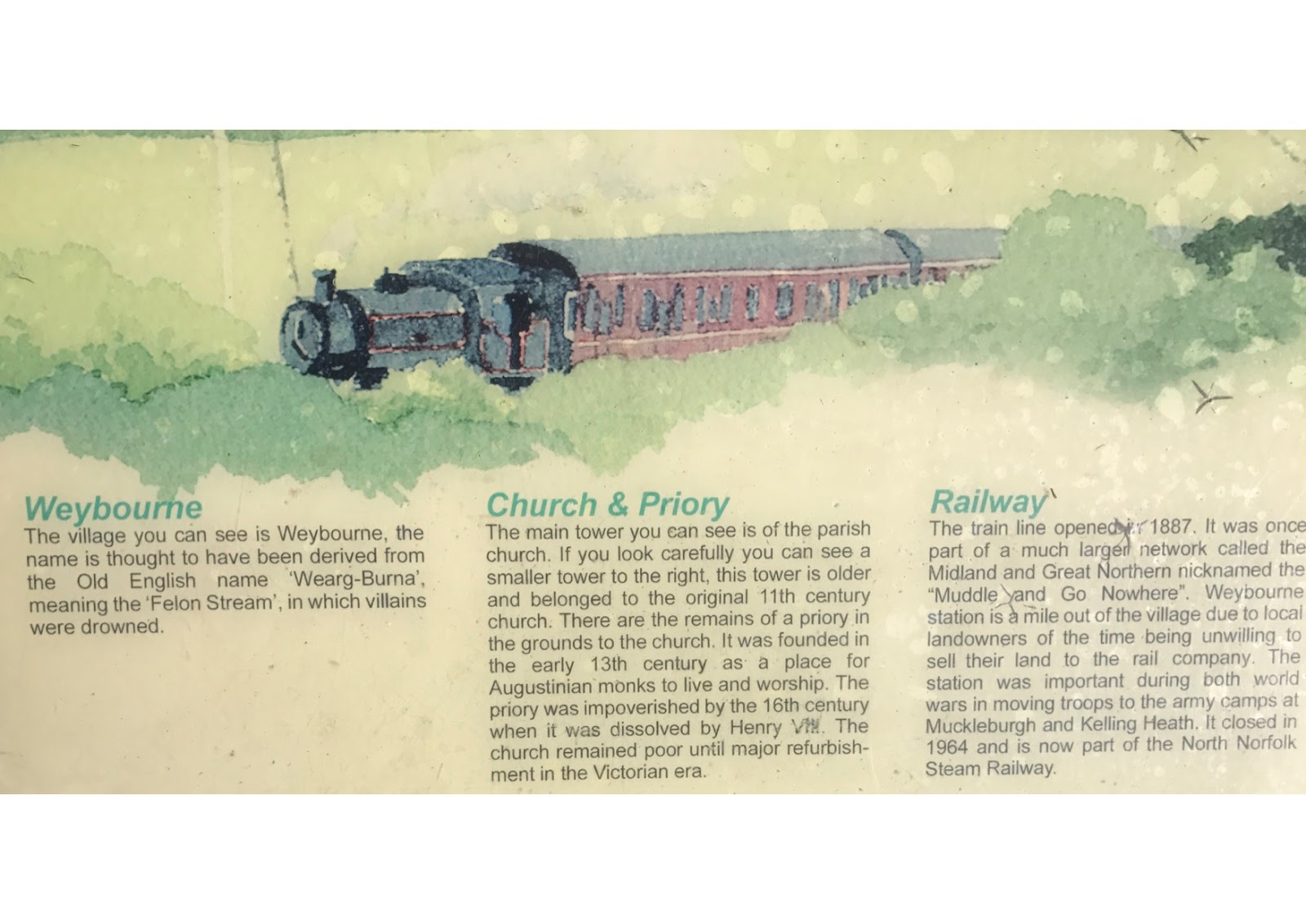
| Weybourne station |
 |
| Kelling church window |
If you would like to share your experiences of any of the
landscapes discussed in this blog please record them in the Comments section.
Books on Kelling and Norfolk
Anyone wishing to know more about the
mythical county of Norfolk in general and Kelling in particular can try one of
these. In my opinion, none quite capture the allure of Kelling and its
landscape.
The King’s England; Arthur Mee; Hodder & Stoughton; 1940
The Story of a Norfolk Farm; Henry Williamson; 1941
Norfolk; Doreen Wallace and R.P. Bagnall-Oakley; Robert Hale; 1951
Norfolk; Wilhelmine Harrod; Faber and Faber; 1958
The Shell Guide to England; ed. John Hadfield; Michael Joseph; 1970
The Prostitute’s Padre; Tom Cullen; 1975
The Birth of a Village: A History of High Kelling; Gill Baker et al;
High Kelling Society; 2000
The Making of the British Landscape; Nicholas Crane; Weidenfeld &
Nicholson; 2016


